

Why You Keep Repeating the Same Patterns in Life (Your Subconscious Is Running a Hidden Program)
You promise yourself this time will be different.
This time you will not overgive in the relationship.
This time you will not shrink yourself in the meeting.
This time you will not procrastinate until the last moment.
This time you will not chase the unavailable person, undercharge for your work, or abandon your own goals halfway through.
And yet… somehow, you end up in the same emotional place again.
Different year. Different face. Different situation.
Same pain.
If that has been your experience, let me say this first: you are not lazy, broken, or doomed. More often, you are living from a pattern your subconscious learned long ago — and now repeats automatically until it is seen, interrupted, and changed.
That is why you can know better and still do the old thing.
That is why logic alone does not save you.
And that is why the same lesson keeps returning in different clothes.
In this blog, I’m going to show you why you keep repeating the same patterns, what your childhood has to do with it, how self-sabotage quietly protects old pain, and most importantly, how to break the cycle without overwhelming yourself.
First, Why Do I Keep Repeating the Same Patterns?
Because the subconscious mind is designed to prefer what feels familiar, not what is necessarily good for you.
That is one of the hardest truths to accept.
Most people think they repeat painful patterns because they are weak, careless, or bad at making decisions. In reality, the nervous system often returns to what it already knows. Familiar pain can feel safer than unfamiliar peace. Psychology Today describes this through the idea of repetition compulsion — the tendency to replay old emotional patterns, especially ones rooted in childhood, even when they hurt. Source
So if chaos felt normal when you were young, calm can feel suspicious as an adult.
If love felt conditional, healthy love may feel “boring.”
If being criticised was common, success may feel unsafe because visibility invites judgment.
Your adult life then becomes the stage where old scripts keep performing.
Your Childhood Did Not Just Give You Memories. It Gave You Meanings.
This is where the topic becomes deeply important.
Early childhood is not just a cute phase you “grow out of.” It is one of the most formative periods of brain and emotional development. According to First Things First, 90% of brain growth happens by age 5, and early experiences lay the foundation for later learning, self-regulation, relationships, and resilience. Source
That means the beliefs you formed early were not random. They were adaptive.
A child does not say, “My parent is emotionally unavailable because they are wounded.”
A child says, usually without words:
“It must be me.”
“I am too much.”
“I am not important.”
“Love has to be earned.”
“If I stay quiet, I stay safe.”
Cleveland Clinic explains this beautifully through the idea of the inner child. It notes that between ages 0 and 8, children see the world in a highly self-referenced way, so they often interpret what happens around them as being about their own worth and value. Those interpretations can become deeply ingrained beliefs that continue shaping adulthood. Source
So when people say, “Your subconscious is running a hidden program,” this is what they mean.
Not magic.
Not destiny.
Just an old internal rule that once helped you survive, but now keeps sabotaging your peace.
Why These Patterns Feel So Hard to Break
Because repeating patterns are usually not just habits. They are protective strategies.
That changes everything.
A self-sabotaging pattern often looks irrational on the surface. However, when you go deeper, it makes emotional sense.
For example:
- Procrastination may protect you from the fear of failing publicly
- Perfectionism may protect you from criticism
- Choosing emotionally unavailable partners may protect you from true vulnerability
- Undercharging may protect you from being judged, rejected, or expected to deliver more
- People-pleasing may protect you from conflict or abandonment
Verywell Mind notes that self-sabotage often shows up through procrastination, perfectionism, overthinking, withdrawal, harsh self-criticism, and unrealistic expectations. It also points out that these patterns commonly grow from difficult childhood experiences, past relationships, low self-esteem, and conflicting beliefs. Source
So no — your pattern is not random.
It is trying to solve an old problem with an old strategy.
The issue is that what protected you at 8 may now be quietly ruining your life at 28, 38, or 48.
7 Signs Your Subconscious Is Running an Old Program
If you’ve ever asked, “Why do I keep repeating the same patterns?” these are the signs to watch for.
1. You keep getting different versions of the same outcome
Different job, same feeling of being overlooked.
Different partner, same feeling of being unseen.
Different goal, same cycle of almost-but-not-quite.
2. Your reactions are bigger than the moment
Someone takes longer to reply, and your body reacts like you are being abandoned.
A small mistake happens, and suddenly you feel deep shame.
That mismatch matters.
Cleveland Clinic describes this clearly: sometimes the pain doesn’t match the pinch. In those moments, you are not only reacting to the present — an older wound is also active. Source
3. You know what to do, but you still don’t do it
This is classic subconscious conflict.
Your conscious mind wants change.
Your subconscious mind wants safety.
4. You sabotage progress right before a breakthrough
You disappear, delay, pick a fight, numb out, or convince yourself it does not matter.
5. You attract what feels familiar, not what is healthy
This is especially common in relationships, work environments, and money patterns.
6. You keep hearing the same inner sentence
“I’m not enough.”
“I always mess things up.”
“No one really stays.”
“Success changes people.”
That sentence is often the core code.
7. You feel tired of yourself — but do not know how to stop
This is the part most people hide.
They are not only hurt by the pattern; they are ashamed that they still have it.
If that is you, pause here and breathe. Shame will not heal the pattern. Awareness will.
What Childhood Trauma and Adverse Experiences Have to Do With This
Not every repeating pattern comes from major trauma. However, many painful adult loops trace back to early experiences that made you feel unsafe, unseen, unstable, or emotionally alone.
The CDC defines Adverse Childhood Experiences (ACEs) as potentially traumatic events that happen between ages 0 and 17, including abuse, neglect, violence, household instability, and other experiences that undermine safety and bonding. These experiences can affect health, learning, relationships, stress responses, and life opportunities well into adulthood. Source
Cleveland Clinic also notes that childhood trauma can leave lasting mental, emotional, and physical imprints. In fact, children who experience trauma before age 8 may be especially vulnerable, and healing often involves therapy, self-compassion, boundaries, mindfulness, and support. Source
That does not mean you must blame your childhood for everything.
It means you should stop blaming yourself for patterns that were built before you had the tools to choose differently.
That is a much more compassionate — and much more accurate — place to begin.
So How Do You Break a Repeating Pattern?
This is the part that matters most.
You do not break a pattern by shaming yourself harder.
You do not break it by reading one motivational quote and deciding you are “done” with it.
You break it by becoming conscious of the code, interrupting it early, and giving your mind and body a new experience.
Here is a practical process.
1. Name the Pattern in One Honest Sentence
Do not write a paragraph. Write one sentence.
Try:
- “I abandon myself in relationships to avoid being abandoned.”
- “I procrastinate when something matters because I fear being exposed.”
- “I undercharge because a part of me believes I am not worth more.”
- “I stay confused because clarity would force action.”
This step matters because vague pain stays powerful. Clear pain becomes workable.
2. Identify the Trigger, Not Just the Outcome
Most people focus on the crash. Instead, study the first moment.
Ask:
- What happened right before I repeated the pattern?
- What did I feel in my body?
- What thought arrived first?
- What story did my mind instantly create?
For example:
- Trigger: someone did not reply
- Body: tight chest
- Thought: “I’m being ignored”
- Story: “I don’t matter”
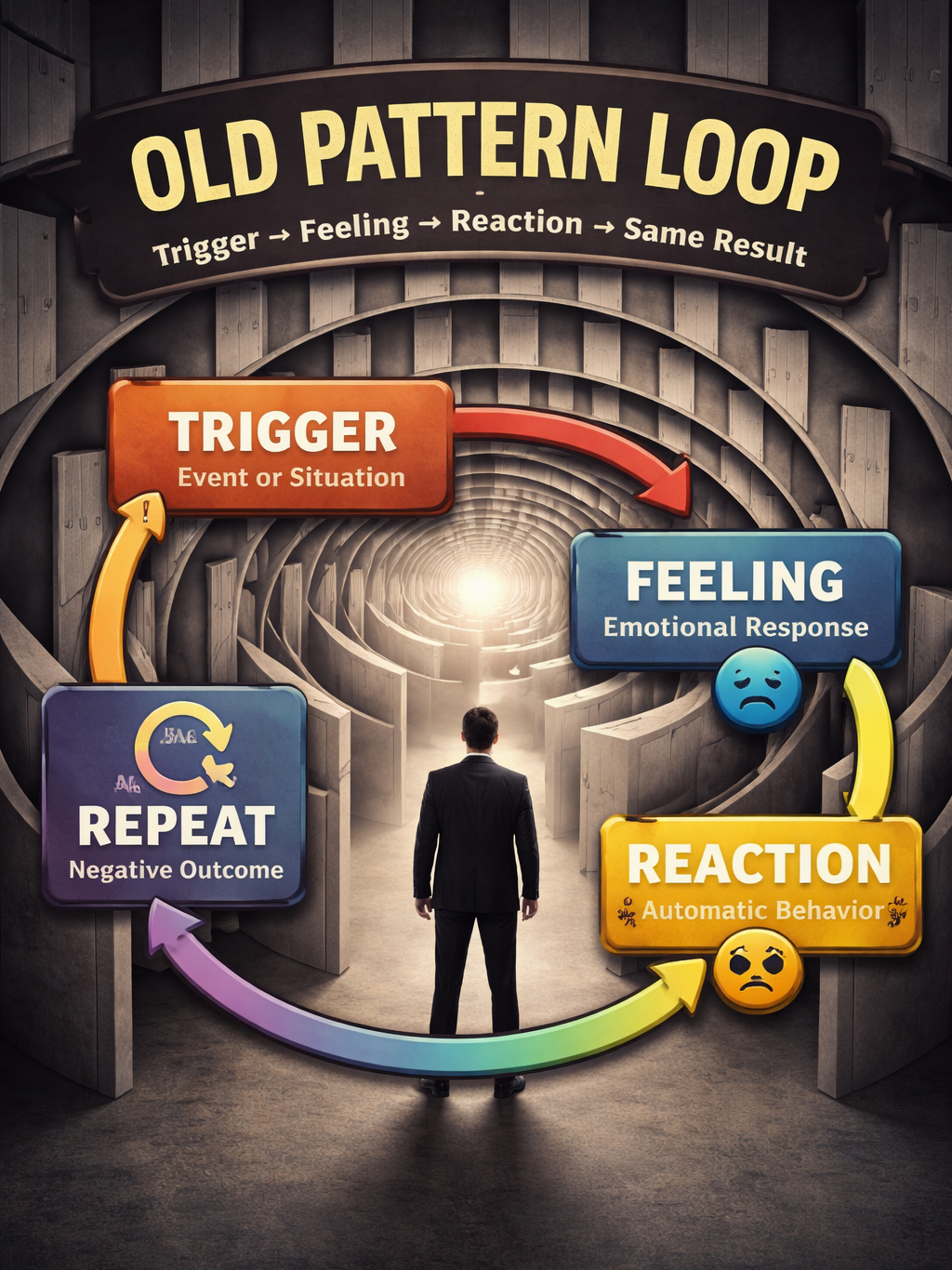
That is the moment the old program switches on.
3. Find the Hidden Belief Underneath It
Every repeating pattern is usually protecting a belief.
Common ones include:
- I am not enough
- I am too much
- Love must be earned
- Success is not safe
- If I relax, everything will fall apart
- People always leave
- I have to do everything alone
Once you see the belief, the pattern makes sense.
This is why deep change often feels emotional, not just intellectual. You are not only updating behavior. You are updating identity.
4. Use a Pattern Interrupt Before the Old Loop Finishes
This is where NLP-style pattern interruption becomes incredibly useful.
A pattern interrupt means you break the old sequence before it completes itself.
If the old loop is:
trigger → fear → overthinking → self-sabotage → regret
then your job is to interrupt it between fear and self-sabotage.
Simple ways to do that:
- stand up and change physical state immediately
- say out loud: “This is an old pattern, not the whole truth”
- write the old belief and then challenge it
- call a trusted person instead of isolating
- take one tiny action within 5 minutes
- delay the impulsive reaction by 20 minutes
This may sound small. Still, small interruptions create new pathways.
Verywell Mind recommends examining root causes, stopping procrastination, reducing perfectionistic thinking, and focusing on smaller, more manageable changes rather than all-or-nothing decisions. Source
That is exactly the point: do not wait for a giant transformation. Break the loop at the first opening.
5. Give Yourself New Evidence
Your subconscious changes through repetition and emotional experience.
So once you see the pattern, you must build evidence against it.
If your belief is “I am not worthy unless I overperform,” your new evidence might be:
- charging properly
- speaking once in the meeting
- saying no without a long apology
- asking for what you need
- finishing imperfectly instead of endlessly preparing
At first, these actions feel unnatural. That is okay. The old pattern also once felt unnatural — until you repeated it enough.
The goal is not to “feel ready.”
The goal is to practice a new reality until it becomes familiar.
6. Work at the Level of the Wound, Not Only the Symptom
This is where many people get stuck.
They try to fix:
- overthinking
- self-sabotage
- clinginess
- avoidance
- under-earning
- procrastination
But they never address the wound underneath.
If the wound is abandonment, then relationships will keep triggering it.
If the wound is shame, then achievement will keep triggering it.
If the wound is unworthiness, then money, visibility, love, and success may all trigger it.
So yes, practical strategies matter. But deeper healing matters too.
And sometimes the most effective work is not a hundred techniques. Sometimes it is one honest moment: “This pattern is old. It protected me once. But I do not want to live from it anymore.”
That is where change begins.
A Simple Reframe You Can Use Today
When you catch yourself repeating the old pattern, say:
“This is not my personality. This is a learned protection pattern. And learned patterns can change.”
Read that again.
Not your destiny.
Not your identity.
A learned pattern.
That one shift alone can create relief.
If You Want to Go Deeper, Ask Yourself These 5 Questions
- What pain am I unconsciously trying to avoid?
- What familiar feeling do I keep recreating?
- What did I learn early about love, safety, money, or success?
- What part of me still believes this pattern is protecting me?
- What would feel unfamiliar — but healthier — here?
Journal honestly. Don’t write what sounds wise. Write what feels true.
Can You Really Change a Pattern That Has Been With You for Years?
Yes — but not by pretending it does not exist.
Patterns change when:
- they are identified clearly
- the nervous system feels safer
- the old belief is challenged consistently
- new behavior is repeated
- the deeper wound is supported, not shamed
Change is possible. However, it rarely happens through self-attack.
It happens through awareness, honesty, repetition, and support.
Quick Summary
If you keep repeating the same patterns in life, it usually means:
- your subconscious learned an old rule early
- that rule still feels safer than change
- your nervous system keeps choosing familiar pain
- self-sabotage is often protection, not failure
- real change happens when you identify the belief, interrupt the loop, and create new evidence
If This Resonated With You…
If your career keeps stalling, your relationships keep repeating the same pain, or your inner world feels like the same loop in a different form, you do not need more self-blame. You need the right kind of support.
Start here:
- Explore how I work on the Work With Me page
- Learn more about the space I’ve created at Heal With Anchal
- Or reach out when you feel ready and start with your free first session
If this resonated, your first session with me is completely FREE.
Together, we can identify the real block behind the repeating pattern and begin shifting it from the root.
Leave a Reply